Mastering the Movement: The Art of the Sled Push and Wall Ball
HYROX Movement Strategies
By
July 6, 2026

If you look at the whiteboard on any given week, there are two movements guaranteed to send a collective shiver through the room: the sled push and the wall ball.
Separately, they are brutal tests of leg drive and lung capacity. Put them together or mix them into a heavy CrossFit AMRAP or a grueling HYROX simulation and they can completely redline your engine if you don’t respect them.
But here’s the secret: these movements aren’t just about raw power or suffering through the burn. They are highly technical. When you master the mechanics and efficiency of the sled and the wall ball, you stop fighting the equipment and start moving with purpose.
Let’s break down the exact technical tweaks, body positions, and pacing strategies you need to shave seconds off your time and save your shoulders and legs from premature burnout.
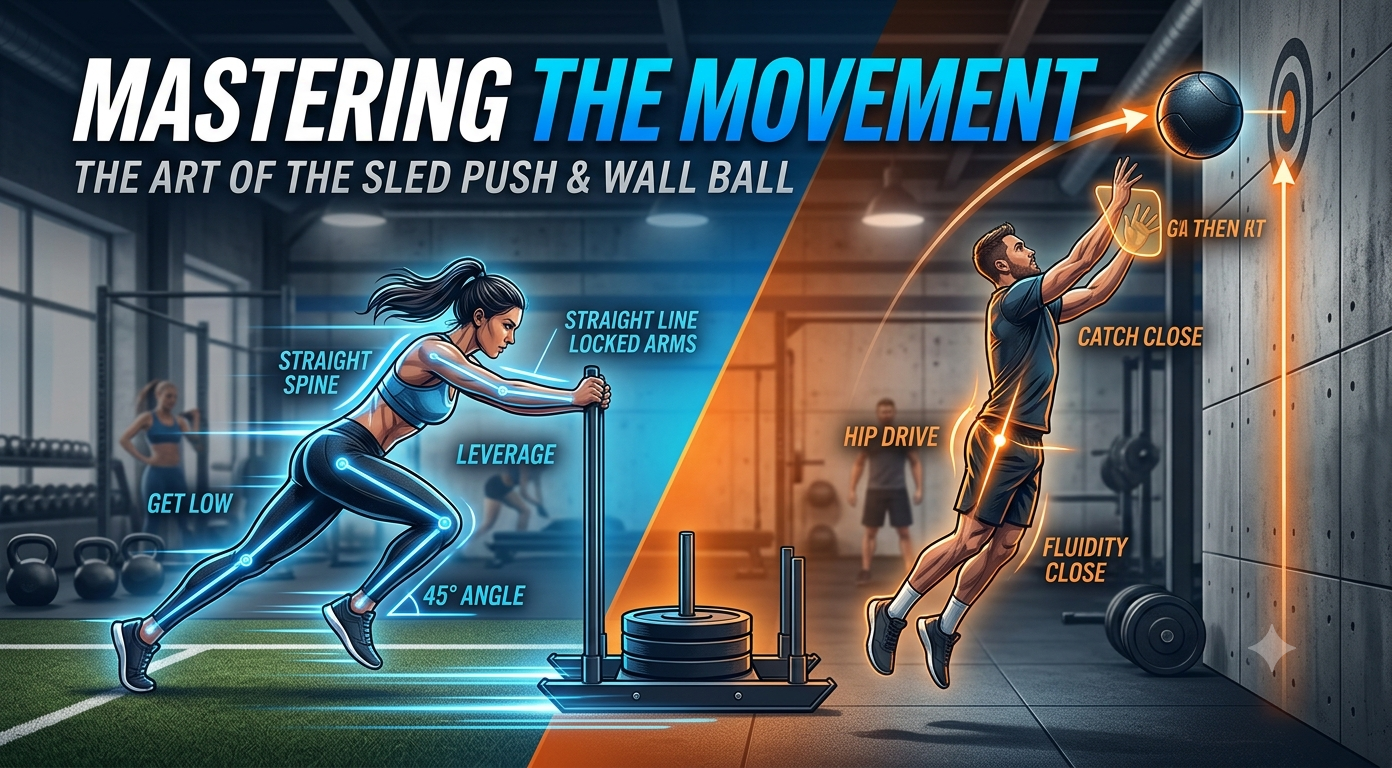
The sled push is the ultimate equalizer. There is no eccentric (lowering) phase, which means it won’t make you as sore as heavy squats, but it requires massive output. The biggest mistake athletes make is trying to use pure, chaotic force rather than leverage.
The moment you stand up too tall, your power disappears. You want your body at a 45-degree angle to the floor. Think of creating a straight line from your ears, through your shoulders and hips, right down to your heels.
You have two options for your upper body, and both require total rigidity:
When people get tired, they start taking long, lunging strides. This causes your hips to shift side to side, leaking energy. Instead, think of your legs as short, rapid pistons. Keep your feet tracking directly under your hips and stay high on your toes to maintain constant forward momentum.
The wall ball is a beautiful, fluid movement until about rep fifteen, when the ball starts feeling like a boulder and your shoulders start screaming. If you feel wall balls primarily in your upper body, your mechanics are upside down.
Never catch the ball with open, wide hands out in front of your face. You want to create a solid shelf. Catch the ball tight to your chest, keeping your elbows tucked directly underneath it.
A wall ball is a front squat followed by a push press; it is not a strict shoulder press. You should not begin pushing the ball with your arms until your hips have completely locked out at the top of the squat.
Watch elite athletes do high-rep wall balls, and you’ll notice a subtle trick: the moment the ball leaves their hands, they drop their arms down for a split second before reaching back up to catch it. Keeping your hands up in the air the entire time cuts off blood flow and fatigues your shoulders. Let them drop, shake them out for a micro-second, and breathe.
Whether you are tackling these movements in a classic CrossFit workout or prepping for a Hyrox race, the strategy remains the same: unbroken is a trap if it causes you to redline.
Next time you see the sled or the wall ball programmed, don't just brace for impact. Focus on the posture, leverage, and efficiency. Small tweaks make a massive difference.